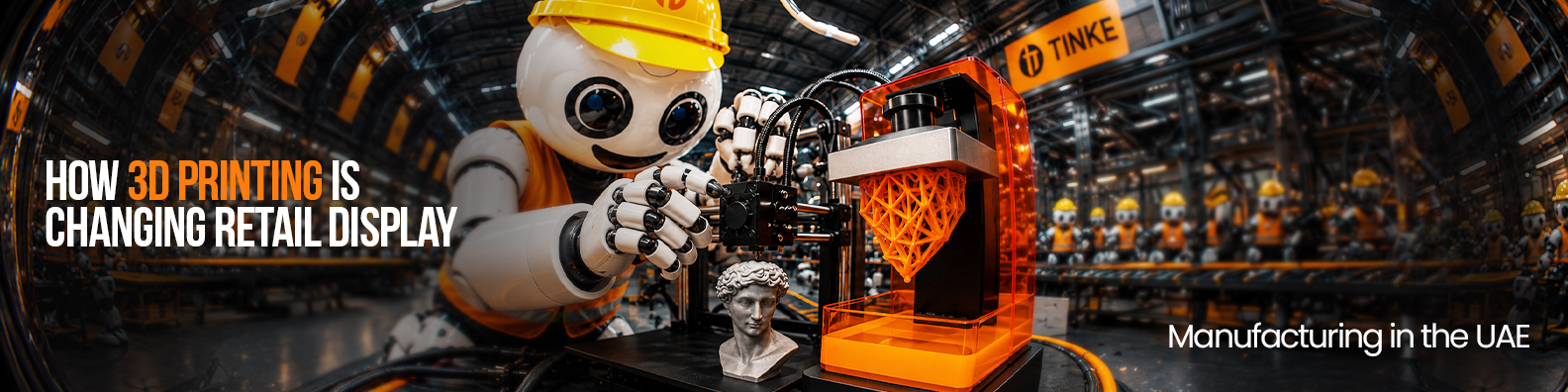
How 3D Printing Is Changing Retail Display Manufacturing In The UAE & KSA
UAE and KSA retail is no longer just about placing products on shelves; it is about staging moments that make people stop, look, and remember. From flagship stores to mall activations and seasonal pop-ups, every display is expected to work like a silent salesperson, drawing attention while staying true to the brand. This is why brands now need displays that are functional, memorable, precise, scalable, and fast to produce. In a market where attention is always on the move, custom retail displays have become less of a nice-to-have and more of a retail necessity. This is where 3D printing begins to change the conversation. While traditional fabrication remains essential for structure, finishing, and installation, 3D-printed prototyping helps brands move from digital idea to physical sample with far greater speed and flexibility.
What Makes 3D Printing Relevant To Retail Display Manufacturing?
Simply put, 3D printing takes a digital design and builds it into a physical form, one layer at a time. The process begins with a 3D file or blueprint, giving brands a faster way to move from an idea on screen to a sample they can see, hold, test, and refine. For retail display manufacturing in the UAE, that is a serious advantage. Instead of waiting through long sampling cycles, brands can review proportions, check functionality, adjust details, and make better production decisions earlier.
This matters because modern retail displays can no longer afford to look generic. Brands need product holders, decorative props, signage elements, sculptural pieces, visual merchandising units, and campaign-specific components that fit the product, the space, and the story. 3D printing gives teams more freedom with form, texture, scale, and detailing, making complex ideas easier to explore before the final build begins. That is why 3D printing in the UAE and KSA is becoming increasingly relevant for brands that want speed, flexibility, and a flawless output.
Team Visual Solutions supports this shift through prototyping, custom part production, and small-batch manufacturing using materials such as PLA, ABS, resin, PETG, and specialty filaments. Our team also helps optimize models for printability and functionality, guide material choices, and complete post-processing through sanding, painting, assembly, and finishing. Backed by wider fabrication capabilities across signage, acrylic, metal, joinery, CNC, electrical work, and installation, we help brands manage custom display production from concept to completion with greater control and consistency.
10 Ways 3D Printing Is Transforming Retail Display Manufacturing In The UAE & KSA
1. It makes prototyping faster and more practical.
3D printing helps brands move from a digital concept to a physical sample with far less waiting time. Instead of depending only on renders or drawings, teams can review the size, shape, balance, and functionality of a real prototype before final production begins.
2. It gives brands more freedom in shape and design.
Retail displays no longer have to stay within the safe limits of standard shelves, stands, and flat panels. With 3D printing, brands can explore curved forms, organic shapes, intricate textures, sculptural props, and product-specific designs with greater ease.
3. It supports custom display production without unnecessary tooling.
Many retail campaigns in the UAE need limited quantities, not mass production. 3D printing makes small-batch display components, props, and accessories easier to produce without committing to expensive molds or tooling too early.
4. It helps brands respond faster to campaign timelines.
Retail calendars move quickly, especially around Ramadan, Eid, National Day, Dubai Shopping Festival, mall activations, and product launches. Because changes can be made at the digital model stage, 3D printing helps teams refine ideas faster and avoid starting from scratch every time a detail changes.
5. It improves accuracy for product-specific displays.
A display must not only look good; it must hold the product correctly, fit the space, and support shopper interaction. 3D printing helps create accurate holders, brackets, connectors, clips, and modular parts designed around the exact shape and size of the product.
6. It bridges the gap between design and fabrication teams.
A retail display may look brilliant in a render, but it still has to work in the real world. 3D printing gives designers, fabricators, and clients a physical reference early in the process, making it easier to spot issues in scale, balance, structure, or assembly before full production.
7. It works well with traditional fabrication methods.
3D printing is not here to replace acrylic, metal, wood, lighting, painting, CNC, or installation work. Its real strength is in working alongside these methods, creating printed components or props that can be finished, assembled, and integrated into larger retail display builds.
8. It supports better finishing and display-ready output.
A 3D printed piece does not have to look raw or experimental. With sanding, painting, assembly, and surface finishing, it can be turned into a polished retail-ready element suitable for counters, shelves, window displays, and brand activations.
9. It reduces waste during sampling and revisions.
3D printing can make the trial-and-error stage more controlled because changes are made digitally before producing the next version. This helps reduce unnecessary full-scale sampling, repeated rework, and wasted material during the early development phase.
10. It helps create modular and adaptable display systems.
Retail displays often need to adapt across different stores, product ranges, and campaign phases. 3D printing can help create interchangeable holders, decorative add-ons, and modular parts that can be updated without rebuilding the full display.
Conclusion:
3D printing is giving retail display manufacturing in the UAE and KSA a faster, sharper, and more flexible way forward. It helps brands test ideas earlier, refine details with greater accuracy, and create display elements that feel relevant for the product, the space, and the campaign. When combined with traditional fabrication and premium finishing, it becomes a powerful way to turn creative concepts into retail-ready experiences.
Ready to bring your next retail display idea to life? Connect with Team Visual Solutions for 3D printing, prototyping, custom display production, and complete fabrication support from concept to final installation.

![A ready-made display can fill a space, but custom joinery makes the brand stand out.
Premium displays are not just assembled; they are crafted..
DM us to get started on your next custom display build.
[custom joinery, retail display, woodwork fabrication, display build, custom displays]
#teamvisualsolutions #customjoinery #retaildisplay #customdisplays #dubai](https://teamvisualsolutions.com/wp-content/uploads/sb-instagram-feed-images/728984260_18530869273072499_8674034970005547316_nfull.webp)
![The ideal surface is not a default choice; it depends on what the display must carry, reflect, withstand, and communicate.
Send us your brief. We’ll help match the material to the job.
[metal fabrication, acrylic fabrication, woodwork, fibre glass, marble finish]
#teamvisualsolutions #materialmatters #customfabrication #visualexcellence #dubai](https://teamvisualsolutions.com/wp-content/uploads/sb-instagram-feed-images/728597342_18530422210072499_7885168798854204281_nfull.webp)
![A kiosk is never just a shell.
A strong build considers structure, storage, customer flow, lighting, branding zones, and how the product is seen first.
Share your kiosk brief with us.
[custom kiosks, kiosk design, retail kiosk, mall activation, brand display]
#teamvisualsolutions #customkiosks #kioskdesign #retaildisplay #dubai](https://teamvisualsolutions.com/wp-content/uploads/sb-instagram-feed-images/726294882_1013051901211893_4567144479825373241_nfull.webp)
![The Islamic New Year is a moment to reflect, realign, and move forward with purpose.
May this new beginning bring clarity, progress, and meaningful growth to every vision being built.
Wishing you a blessed Islamic New Year from Team Visual Solutions.
[islamic new year, hijri new year, brand message, new beginnings, visual solutions]
#teamvisualsolutions #islamicnewyear #hijrinewyear #newbeginnings #dubai](https://teamvisualsolutions.com/wp-content/uploads/sb-instagram-feed-images/702857057_18523989073072499_6543042334504091662_nfull.webp)
![In travel retail, attention moves fast.
A good duty free display presents the product clearly, gives it a premium feel, and draws people in seconds.
Share your duty free display brief with us.
[duty free, travel retail, airport display, product display, retail fixture]
#teamvisualsolutions #dutyfree #travelretail #customdisplays #dubai](https://teamvisualsolutions.com/wp-content/uploads/sb-instagram-feed-images/702910895_18523988602072499_4801997597413588173_nfull.webp)
![Your kiosk should stop people, not blend in.
With a smart structure, effective lighting, refined finish, and easy product access, even a small footprint can carry a strong brand presence.
Share your kiosk brief with us.
[mall kiosk, premium kiosk, retail display, custom kiosk, brand activation]
#teamvisualsolutions #customkiosks #retaildisplay #displayinnovation #riyadh](https://teamvisualsolutions.com/wp-content/uploads/sb-instagram-feed-images/703727646_18523987903072499_3091309865329304578_nfull.webp)
![An exhibition stand shouldn’t just stand there; it should turn heads, start conversations, and make the brand hard to forget.
Let’s discuss your next exhibition stand brief.
[exhibition stand, custom stand, event display, brand activation, exhibition build]
#teamvisualsolutions #exhibitionstands #customdisplays #brandactivation #riyadh](https://teamvisualsolutions.com/wp-content/uploads/sb-instagram-feed-images/702910893_18523987831072499_292277922264343587_nfull.webp)
![A retail space becomes a brand experience, only when fixtures, signage, lighting, flooring, and finishes are planned together from the start.
What part of your space needs rethinking?
Send us your site photo. We’ll help map the opportunity.
[shop fit out, retail fit out, store fitting, retail transformation, branded space]
#teamvisualsolutions #shopfitout #retailfitout #brandedspaces #dubai](https://teamvisualsolutions.com/wp-content/uploads/sb-instagram-feed-images/703275443_18523987426072499_2056860186685689517_nfull.webp)
![A display should do more than look beautiful.
It should stop the stroll, frame the product, and make the brand worth stepping into.
Send us your storefront reference. We’ll help bring it to site.
[window display, luxury retail, storefront design, visual merchandising, brand display]
#teamvisualsolutions #windowdisplays #visualmerchandising #luxuryretail #riyadh](https://teamvisualsolutions.com/wp-content/uploads/sb-instagram-feed-images/706474271_18523986895072499_473158534016570906_nfull.webp)
![Complex shapes should not be cut down to fit old production limits.
With in-house 3D printing, TVS helps brands build intricate, sculptural, and large-scale display ideas with more control from concept to final execution.
What is one display idea your brand has been waiting to bring to life?
DM us your brief.
[3d printing, custom displays, large scale printing, retail display, display fabrication]
#teamvisualsolutions #3dprinting #customdisplays #retaildisplay #customfabrication dubai](https://teamvisualsolutions.com/wp-content/uploads/sb-instagram-feed-images/712724103_4631951233758106_639224042776033565_nfull.webp)
![3D printing is not just about making an idea visible. It helps test scale, shape, joints, balance, and finish before production moves further.
Share your concept or reference with us.
[3d printing, rapid prototyping, display props, kiosk parts, custom fabrication]
#teamvisualsolutions #3dprinting #rapidprototyping #customfabrication #dubai](https://teamvisualsolutions.com/wp-content/uploads/sb-instagram-feed-images/704149404_18523986457072499_4705555923812169492_nfull.webp)
![The less a project gets passed around, the more control, speed, and finish it carries to site.
At TVS, metal fabrication, 3D printing, joinery, acrylic work, painting, powder coating, and installation come together inside one 65,000 sq. ft. Dubai facility.
From fabrication to installation, TVS delivers across UAE and KSA.
Share your next display brief with us.
[custom fabrication, retail displays, 3d printing, metal fabrication, display build]
#teamvisualsolutions #customfabrication #retaildisplays #dubai #riyadh](https://teamvisualsolutions.com/wp-content/uploads/sb-instagram-feed-images/703069345_2099024207330627_4084435951703886461_nfull.webp)
![The smartest kiosk projects do not start with color. They start with footprint, storage, power, flow, and what the customer actually sees first.
Share your kiosk brief with us.
التصميم الذكي يبدأ من الأساس
المساحة، التخزين، الحركة… ثم الشكل.
شاركنا تفاصيل مشروعك لنساعدك في التنفيذ.
[kiosk checklist, retail kiosk planning, customer flow design, branded kiosk, approval ready kiosk]
#teamvisualsolutions #customkiosks #kioskdesign #displayinnovation #dubai](https://teamvisualsolutions.com/wp-content/uploads/sb-instagram-feed-images/702836637_18523573879072499_3627428870726398436_nfull.webp)
![A prototype can reveal issues a screen often hides, like weak joints, awkward assembly, wall thickness problems, balance, or finishing complications.
That is where smarter production starts.
Share your concept or reference with us. We’ll help test it before it gets expensive.
ما لا تظهره الشاشة، يكشفه النموذج الأولي.
من تفاصيل الوصلات إلى سهولة التركيب والتوازن وجودة التشطيب، تبدأ الرؤية الحقيقية هنا.
وهنا يبدأ الإنتاج بشكل أكثر ذكاءً.
شاركنا فكرتك أو المرجع، وسنساعدك على اختبارها قبل الانتقال إلى التنفيذ الكامل.
[3d printing, prototype testing, production planning, fabrication process, custom display build]
#teamvisualsolutions #3dprinting #rapidprototyping #customfabrication #dubai](https://teamvisualsolutions.com/wp-content/uploads/sb-instagram-feed-images/702894835_18523573459072499_6158097669275211731_nfull.webp)
![Eid Al Adha is a time for gratitude, togetherness, and meaningful new beginnings.
Wishing our clients, partners, teams, and communities a blessed Eid filled with peace and progress.
[eid al adha, eid mubarak, festive greeting, brand message, team visual solutions]
#teamvisualsolutions #eidaladha #eidmubarak #festivegreetings #dubai](https://teamvisualsolutions.com/wp-content/uploads/sb-instagram-feed-images/703967200_18523920784072499_1960932700836121951_nfull.webp)
![Blending in is expensive in retail.
Your kiosk, display, or installation has only seconds to show the brand, guide attention, and make people stop.
At Team Visual Solutions, we build custom retail displays that turn your brief into something shoppers actually notice.
DM us your brief and let’s build what your brand should look like on ground.
[custom kiosk, retail display, brand activation, display build, visual merchandising]
#teamvisualsolutions #customdisplays #retaildisplay #brandactivation #dubai](https://teamvisualsolutions.com/wp-content/uploads/sb-instagram-feed-images/702374246_968559969300447_5040972746537684223_nfull.webp)
![Everything under one roof means fewer handovers, tighter control, and cleaner execution on site.
A polished display may look effortless on site, but behind it is heavy-duty machinery, meticulous planning, and a team taking the build from fabrication to final installation.
Share your next display brief with us.
[custom fabrication, retail displays, mall installations, display build, in-house production]
#teamvisualsolutions #customfabrication #retaildisplays #displaybuild #dubai](https://teamvisualsolutions.com/wp-content/uploads/sb-instagram-feed-images/702991274_18523571884072499_8364584279962929505_nfull.webp)
![Different briefs. Different surfaces. Different environments. But the standard remains the same.
Share your next execution brief with us.
قد تختلف المشاريع والأسطح والبيئات…
لكن مستوى الجودة يظل ثابتاً.
أرسل لنا تفاصيل مشروعك لنبدأ.
[execution showcase, retail displays, custom signage, exhibition build, installation work]
#teamvisualsolutions #customdisplays #creativedisplays #visualexcellence #riyadh](https://teamvisualsolutions.com/wp-content/uploads/sb-instagram-feed-images/703240697_18523290574072499_4951579110399318627_nfull.webp)
![You only have two seconds to stop a shopper.
Acrylic helps make those seconds count with clarity, clean edges, and a premium finish that pulls attention in.
Share your acrylic display brief with us.
[acrylic fabrication, acrylic display, retail display, display cases, custom fabrication]
#teamvisualsolutions #acrylicfabrication #customdisplays #retaildisplay #dubai](https://teamvisualsolutions.com/wp-content/uploads/sb-instagram-feed-images/701496207_1653505735902050_8044466421542994863_nfull.webp)